

Board Performance · 2025
In this section13 topics
- Prevention of Conflicts of Interest3 items
- Prevention of the Use of Inside Information3 items
- Anti-Corruption4 items
- Whistleblowing4 items
- Selection of Directors & Chief Executives6 items
- Selection of Independent Directors2 items
- Director Development1 item
- Evaluation of Board & Subcommittee Performance3 items
- Subcommittees1 item
- Meeting Attendance & Remuneration5 items
- Supervision of Subsidiaries & Associated Companies4 items
- Audit Committee Duty Performance1 item
- Executive Committee Duty Performance1 item
Prevention of Conflicts of Interest
Has the Company Acted to Prevent Conflicts of Interest?
Yes
Operations in the Past Year
Report of conflict of interest of Directors and Executives
Directors and executives are required to file reports on their own or any related person’s interests regarding the management of the Company or any of its subsidiaries in accordance with the stipulated rules and regulations. Since these may cause conflicts of interest and can lead to the siphoning of assets, it is imperative for these to be disclosed in full. These reports ensure that all directors and executives adhere to the fiduciary duties they are bound to. The Company Secretary acknowledges, signs, and submits these reports to the Chairman of the Board and the Chairman of the Audit Committee within 7 days of their submission in compliance with Section 89/16 of the Securities and Exchange Act, B.E. 2535 (As amended).
In 2024, all members of the Board of Directors updated “Report on the interests of Directors and Executives”. In addition, new members of the Board of Directors and executive filed “Report on the interests of Directors and Executives”. Such reports were submitted to Chairman of the Board of Directors and Audit Committee in accordance with relevant regulation.
Report of Conflict of Interest of Employee
The Group continuously strives for good corporate governance practices to maintain its sustainable development. To ensure professionalism and integrity in conducting our business, the Group has reviewed its Code of Ethics to minimize potential conflicts of interest between employees and the Company. Potential conflicts of interest covered by the Code of Ethics include those involving family members of employees - parents, full-blooded brother/sister, legal spouses, children and adopted children.
While all employees are required to acknowledge their review of the Company’s Code of Ethics, there is an additional requirement for the Board of Directors, all Management, and all employees in sales, procurement and purchase, to sign and submit the “Conflict of Interest: Acknowledgement and Disclosure” form. They have a responsibility to promptly notify the Group Management in writing, with an acknowledgement by the Chief People Officer, if they at any time become aware of any actual or potential conflicts of interest, or if the information provided becomes inaccurate or incomplete.
Therefore, all actual and potential conflicts of interest must be disclosed whenever management and employees are discussing and making decisions related to any business matter.
In 2025, 100% of defined staffs signed the Conflict of Interest declaration form.
Number of Conflict-of-Interest Cases
| Metric | Current Year | Previous Year | Two Years Ago |
|---|---|---|---|
| Total number of cases or issues related to conflicts of interest (cases) | 0 | 0 | 0 |
Prevention of the Use of Inside Information
Has the Company Acted to Prevent the Use of Inside Information?
Yes
Operations in the Past Year
The Company has an established policy and Code of Ethics governing the use of internal information, which have been incorporated into employee regulations with penalties for executives or employees who disclose internal information to outsiders for personal gain with the following details:
Directors and executives, as well as their spouses, cohabitating partners, and minor children under legal age, including legal entities where they have more than 30% shareholding of the number of all voting rights of the juristic person, according to Article 258 of the Securities and Exchange Act of 1992, must notify and distribute information about shares held, as well as reporting any changes to SEC every time they buy, sell, transfer, or receive shares within three days of the change to comply with Article 59. Failure to do so will lead to punishment, as decreed by Clause 275 of the Securities and Exchange Act of 1992.
In addition, the summary of the shareholding of all directors and top executives is reported quarterly to the Board of Directors' meeting.
Finally, under the Company’s Code of Ethics, the Board of Directors, executives, and employees working in related departments, are prohibited from trading the Company’s shares for 21 days prior to the release of the Company’s quarterly and annual financial statements (blackout period) until the first calendar day after the announcement date.
In 2025, directors and top executives filed transactions as per public disclosure on https://market.sec.or.th/public/idisc/en/r59. In addition, summary of shareholding of director and top executives are reported to the Board of Directors on a quarterly basis. Finally, there were no transactions during the blackout period and insider trading case.
Number of Inside-Information Cases
| Metric | Current Year | Previous Year | Two Years Ago |
|---|---|---|---|
| Total number of cases or issues related to the use of inside information to seek benefits (cases) | 0 | 0 | 0 |
Anti-Corruption
Has the Company Acted on Anti-Corruption?
Yes
Operations in the Past Year
The Board of Directors of the Company adopted an anti-corruption policy with the aim of preventing corruption across all value-chain activities while maintaining vigilant operations. The Risk Management Committee established anti-corruption guidelines alongside a regular monitoring system, the results of which are reported to the Board of Directors. The Company will continuously promote and encourage all employees and stakeholders to raise awareness for the eradication of corruption. Anti-corruption will be part of the orientation program to new employees and all employees shall acknowledge the Code of Ethics annually, which includes anti-corruption prevention.
In 2025, the acknowledgment rate of the Code of Ethics by employees was 100%. There were no cases violating the Group’s Anti-Corruption policy and guidelines in 2025.
Thailand’s Private Sector Collective Action Coalition Against Corruption (CAC)
The Company encourages its directors to attend the Anti-Corruption for Executives ("ACEP") training course, while employees are encouraged to regularly participate in events related to anti-corruption efforts and initiatives.
In 2014, the Company signed the Declaration of Intent in View of Establishing Thailand’s Private Sector Collective Action Coalition Against Corruption ("CAC"). The Company developed its policy, risk assessment framework, procedures, monitoring system, and reporting in accordance with the Self-evaluation Tools of the CAC.
The Company has been recognized as a certified company by the CAC. It was first certified on 10 November 2017 and has since passed all subsequent recertifications on 30 June 2020 and 30 June 2023. This recent certification will be valid until 30 June 2026.
Following the implementation of the self-evaluation tools 4.0 by the Institutes of Directors with effect from July 2021, the Company is undertaking the necessary actions, e.g. risk assessment, policy and guideline reviews, communication, ahead of the next recertification. Risk Assessment is conducted in accordance with the guidelines of the “Self-Evaluation Tool for Anti-Corruption System Development” Version 4.0, which covers risk for subsidiaries. The assessment template includes business activity, risk type, risk description, likelihood, impact, risk score, key control. In addition, the Company’s employees also attended the “Anti-Corruption the Practical Guide ("ACPG")” course that helps organizations create a standard anti-corruption system.
In addition to policy implementation and frequent monitoring and reporting, the Company regularly participates in the anti-corruption events, in which on 9 December 2025, the Company participated in International Anti-Corruption Day (Thailand) “Hero of The Truth” through Facebook live.
Form of Anti-Corruption Operations
| Operation |
|---|
| Review of appropriateness in anti-corruption |
| The participation in anti-corruption projects |
| Assessment and identification of corruption risk |
| Communication and training for employees on anti-corruption policy and guidelines |
| The monitoring of the evaluation of compliance with the anti- corruption policy |
| Review of the completeness and adequacy of the process by the Audit Committee or auditor |
Number of Corruption Cases
| Metric | Current Year | Previous Year | Two Years Ago |
|---|---|---|---|
| Total number of cases or issues related to corruption (cases) | 0 | 0 | 0 |
Whistleblowing
Has the Company Implemented Whistleblowing Procedures?
Yes
Operations in the Past Year
The Group expects all personnel, stakeholders, and external sources to monitor their compliance with corporate governance and the Code of Ethics and encourages them to raise any questions and concerns they may have regarding these policies. In addition, they can report any misconduct or noncompliance, and send their enquiries to the Company Secretary, the Internal Audit, or the Human Resources Department.
Procedures pertaining to the reporting of violations of or non-compliance with the Code of Ethics are known by all employees and must be observed. In the event employees notice (or suspect) a violation of, or non-compliance with, the Code of Ethics, they may direct their questions or complaints by phone, e-mail or letter to any of the following persons:
1. Any independent director
2. Chief People Officer
3. Head of Internal Audit
4. Company Secretary
The above persons shall report such matters to the Chief Executive Officer - if the issue is raised against employees below the Chief Executive Officer level; or to the Board of Directors - if the issue is raised against the Chief Executive Officer and/or any director within 24 hours. The Group shall investigate all complaints with due urgency and confidentiality.
The Chief Executive Officer or Board of Directors shall appoint a fact-finding committee, comprising relevant heads of departments and Human Capital Management. The fact-finding committee is authorized to:
• Investigate facts and witnesses
• Proceed according to relevant measures
• Propose prevention to repeating cases
• Proceed with disciplinary actions and/or prosecution according to the law
All employees are expected to cooperate in the investigations as necessary, which are conducted legally, when there is a complaint of violation or non-compliance with the Code of Ethics.
At the soonest, but no later than 14 days from its instigation, the fact-finding committee shall report the result of the investigation to the Chief Executive Officer or Board of Directors. The Human Capital Management Department shall collect the investigation reports, then notify the whistle-blower and the Board of Directors, as well as the responsible persons against whom the complaint was filed.
Measures for Protection and Compensation
Any person making complaints, reports, or cooperating with a fact-finding investigation shall be protected according to the whistle-blower protection guidelines as follows:
• Those who complain, report, or cooperate may choose not to disclose their identities. However, their identities should be disclosed to the investigators appointed by the Group to facilitate the effectiveness of any such investigations.
• The Company regards such information as confidential and discloses such information only as necessary to ensure the safety of, and prevent harm to, those who report their sources, and other individuals involved.
• Appropriate protection will be provided to those who complain, report, or cooperate if they believe they will be under threat.
• Anyone harmed while providing information to assist the Group’s investigations will be compensated in a fair and appropriate manner.
Number of Whistleblowing Cases
| Metric | Current Year | Previous Year | Two Years Ago |
|---|---|---|---|
| Total number of cases or issues received through whistleblowing channels (cases) | 5 | 5 | 3 |
Details of Whistleblowing Cases
| Status | Period Type | Start of Period | End of Period | Details of the Case or Issue | Investigation Results | Corrective Actions | Case or Issue |
|---|---|---|---|---|---|---|---|
| Incident no longer subject to action | Within (month/year) | 2025-09 | 2025-09 | The Company received a report on alleged illegal conduct by an employee of a subsidiary company. An investigation team was set up for further investigation. | The employee had a prior criminal record before joining the subsidiary company. | The employee admitted to the misconduct and has already been terminated from employment. | 3190 · Description: Compliance with laws, regulations, and rules |
| Incident no longer subject to action | Within (month/year) | 2025-10 | 2025-10 | The Company was notified by an external party that one of the Company's delivery vehicles had been spotted, and that the driver of that vehicle was suspected of committing misconduct against the Company | Upon investigation, it was found that the vehicle in question was not the Company's vehicle. | An additional procedure has been implemented requiring the removal of the Company’s logo from all assets prior to their disposal or sale. | 3189 · Description: Anti-corruption |
| Incident no longer subject to action | Within (month/year) | 2025-11 | 2025-11 | The Company was notified by an internal employee that another employee had engaged in activities that may constitute a conflict of interest. The Company therefore established an investigation committee to determine the facts. | The investigation confirmed that the employee had committed the misconduct. | The Company imposed the highest level of disciplinary action, and the employee has been terminated from employment. | 3191 · Description: Prevention of conflicts of interest |
| Incident reviewed by the organization | Within (month/year) | 2025-12 | 2025-12 | The Company was notified by an internal employee of inappropriate conduct by a supervisor. The Company therefore established an investigation committee to determine the facts. | 3190 · Description: Compliance with laws, regulations, and rules | ||
| Incident no longer subject to action | Within (month/year) | 2025-10 | 2025-10 | The Company was notified by an external party of inappropriate conduct by an employee. The Company therefore established an investigation committee to determine the facts. | The complainant further indicated that they did not wish to pursue the matter. | The employee was warned to maintain appropriate conduct. | 3190 · Description: Compliance with laws, regulations, and rules |
Selection of Directors & Chief Executives
Directors & Chief Executives — Introduction
In accordance with the Group’s policy on Director qualifications and nomination, the N&R committee is in charge of nominating appropriate persons as members of the Board of Directors to the Board of Directors and Shareholders meeting as necessary. As part of director nomination, the N&R committee may consider the director pool from the Thai IOD for potential candidates, if any.
In 2025, new directors were appointed. In this process, the Board of Directors acted upon the recommendations of the N&R Committee, which reviewed and confirmed that, collectively, the Board—together with the newly appointed directors—possesses the requisite skills in accordance with the policies on director qualifications and nomination.
Are Directors Selected Through the Nomination Committee?
Yes
Are Chief Executives Selected Through the Nomination Committee?
Yes
Number of Directors from Major Shareholders
6
Rights of Minority Shareholders on Director Appointment
In our commitment to enhancing the minority right of shareholders, prior to the 2026 Annual General Meeting of Shareholders (AGM), shareholders of the Company were entitled to propose agenda items. Shareholders were allowed to exercise such rights from the period 1 October 2025 to 26 December 2025 for consideration by the Board of Directors. Should any proposed agenda be included in the meeting, the Company will specify in the notice of the meeting that said agenda was proposed by a shareholder.
However, in the case where the proposed agenda was rejected, the Company will inform shareholders of the reasons for its rejection at the AGM. Moreover, any shareholder is entitled to nominate any qualified candidate for election as a Board member in advance. The N&R Committee will consider the proposed nominee(s) together with other nominated persons according to the Company’s criteria for the nomination of directors. The N&R Committee shall then present the nominee(s) to the Board for consideration before proposing them to the shareholders’ meeting for approval. Voting requirement of appointment of Directors Pursuant to Clause 15 of the Company’s Articles of Association, the rules and procedures for electing directors are as follows:
Separate round of voting by the shareholders shall take place for each Director position;
Each shareholder has a voting right of one vote per share for each available Director position;
Each Director position shall be allocated to the person who has received the most affirmative votes, provided that the number of affirmative votes received represents at least three quarters of the total number of votes by shareholders attending the meeting by proxy or physical presence and having the right to vote.
Method of Director Appointment
| Method | Other — Please Specify |
|---|---|
| Other | Each Director must receive the most affirmative votes, provided that the number of affirmative votes received represents at least three quarters of the total number of votes by shareholders. |
Selection of Independent Directors
Criteria for Selecting Independent Directors
Independent directors shall possess the qualifications as specified in the Securities and Exchange Commission’s guidelines. The Company’s definitions of an Independent Director are as follows:
Holding no more than 1% f total voting shares of the Company* including the shareholding of persons related to the independent directors;
Not currently be and has never been executive director, worker, employee, salaried consultant, or controlling partiesf the Company*. Exception: It has been at least two years since the person held the position;
Not related by blood or legally registered with any other directors, executives, major shareholders, controlling parties, or persons who will be nominated as directors, executives, or controlling parties of the Company or subsidiary;
Not currently having and has never had any relations with the Company* that may impede, compromise or interfere with the person having independent views. Also, the person should not currently be and has never been a significant shareholder or controlling person for persons having business relations with the Company*. Exception: It has been at least two years since the person has held the position;
Is not currently and has never been the Company’s auditor*. Also, the person should not currently be or has never been a significant shareholder, controlling person, or partner of current auditor’s auditing firm of the Company*. Exception: It has been at least two years since the person held the position;
Not currently providing or has never provided professional services, legal consulting and financial consulting services to the Company* with a fee of more than THB 2 million per year. Also, the person should not currently be or has never been a significant shareholder, controlling person, or partner of any of our current service providers. Exception: It has been at least two years since the person held the position;
Not currently be a director appointed to represent the Company’s directors, major shareholders, or the shareholders related to major shareholders;
Not currently be operating under similar business nature and significant competition to the Company or subsidiary; or not be a significant partner of the partnership, executive director, salaried worker, employee, or consultant; or holding more than 1% f voting shares of any other companies operating under a similar business nature and significant competition to the Company and subsidiary;
Not under any conditions that may impede the person from having independent views towards the Company’s operations.
Did Any Independent Director Have a Business or Professional Relationship?
No
Director Development
Director Development — Introduction
The Board of Directors has a policy to support and facilitate participation in in-house and external training and in continuous knowledge improvement for directors and executives. The Company has encouraged directors and executives to attend training courses organized by the Thai Institute of Directors (IOD), the Securities and Exchange Commission (SEC), and the Stock Exchange of Thailand (SET).
As of 31 December 2025, there were 7 of the Company’s directors who have participated in the IOD’s Director Certification Program (DCP), and 6 have attended the IOD’s Director Accreditation Program (DAP), in which Mr. Jacques Pastor and Mr. Chaiwat Srivalwat have attended both programs. In conclusion, there were out of 11 directors (84.62%) who have attended essential training programs for the role of director. In addition, the Company Secretary consistently provided the information on new and updated essential and beneficial seminars, trainings, activities and exhibitions to the Board and the executives. The details of the training courses attended by the directors are disclosed in Attachment 1: “Information of Directors, Executives, Controlling Persons, Head of Accounting and Finance, Accounting Controller, and Company Secretary”.
In addition, the Company also places importance on holding orientation sessions for new directors in order to enable new directors to gain a thorough understanding of the Company’s management, business, and governance practices, through a briefing by the Company Secretary and the Company’s executives. These cover the key following topics: mission, vision, shareholding structure, corporate overview of the Company's businesses, the Company’s products and services, structures of the Board of Directors and sub-committees, meeting schedule, the Board of Directors' remuneration policy, director’s shareholding and reports, Silent Period and trainings held by IOD. In 2025, the Company held an orientation session for the 2 newly appointed directors, i.e., Mrs. Anurat Tiamtan and Mr. Supachai Phanyawattano.
Evaluation of Board & Subcommittee Performance
Criteria for Evaluating Board Performance
COLLECTIVE AND INDIVIDUAL SELF-ASSESSMENT OF THE BOARD OF DIRECTORS
The Company applies the Board Self-Assessment form designed by the Stock Exchange of Thailand (“SET”). The assessment consists of (i) A collective Self-assessment and (ii) Individual Self-assessments.
The main objective of the self-assessment form is to evaluate the performance of the Board as a team, and of the Directors as a collective body and on an individual basis, in light of recognized best practices and principles of good corporate governance. The procedures are as follows:
1. The Board of Directors performs self–assessment evaluations under guidelines provided by the SET;
2. The Company Secretary summarizes the self-assessment results of all members of the Board of Directors; and
3. The Company Secretary reports the self-assessment results to the Board of Directors and ensures the results are used to improve the performance of the Board.
The 6 categories covered by the collective and individual Self-Assessment Forms are as follows:
1. Structure and qualifications of the board (Collective and individual)
2. Roles, duties and responsibilities of the board (Collective and individual)
3. The board meetings (Collective and individual)
4. Duties of Directors (Collective)
5. Relationship with Management (Collective)
6. Director’s self-improvement and management training (Collective)
SELF-ASSESSMENT OF SUB-COMMITTEES
The sub-committees, comprising the Executive Directors Committee, the Audit Committee, the Nomination and Remuneration Committee, and the Sustainable Development and Corporate Governance Committee shall perform self-assessments once a year to reflect operation efficiency under the principles of good corporate governance in compliance with the Corporate Governance Report ("CGR"). These self-assessments include (i) collective self-assessments of the sub-committees and (ii) individual self-assessments of the sub-committees. Procedures are as follows:
The sub-committees perform self-assessment evaluations under the principles of good corporate governance of the Thai Institute of Directors Association ("IOD") and guideline practices of Sub-committees;
The Company Secretary summarizes and
reports the self-assessment results to the
Sub-committees and ensures the results are
used to improve performance of all the
sub-committees; and
The Company Secretary reports the self-assessment results of the Sub-committees to the Board of Directors.
The categories covered by the collective and individual self-assessment forms of the sub-committees are as follows: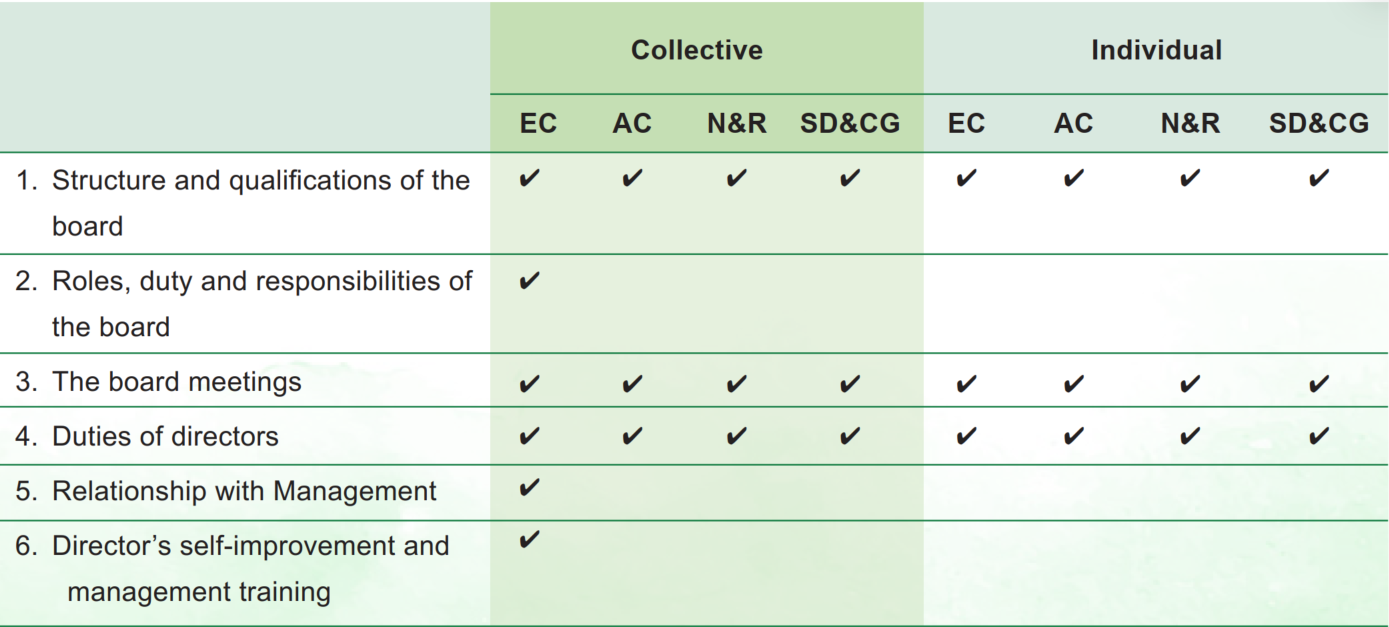
The Company records and reports the assessment results of both the Board of Directors and the Sub-committees to all Directors for their acknowledgement.
PERFORMANCE ASSESSMENT OF THE CHIEF EXECUTIVE OFFICER AND TOP EXECUTIVES
The Nomination and Remunderation committee assesses the performance of the Chief Executive Officer (CEO) and other executive officers based on the Company’s operating results, implementation of the Board’s policies, BSC (Balanced Scorecard) financial and non-financial performance, e.g. maintaining CGR score, recertification for CAC program. The Nomination and Remuneration committee will then consider the appropriate remuneration for the Chief Executive Officer and Executive Directors and propose these to the Board for approval.
As part of the assessment of CEO, the Board also conducts its own CEO self-assessment by using the form recommended by the SET. The main objective of the self-assessment form is to evaluate the performance of the CEO.
THE 3 CATEGORIES COVERED BY THE CEO SELF-ASSESSMENT FORM ARE AS FOLLOWS:
Status of achievements;
Performance measures, e.g. strategy formulation, financial planning, non-financial
KPI, such as CGR score; and
Development needs
In 2025, assessment score from CEO self-assessment form was 3.85 out of 4.00. The assessment of CEO is satisfactory according to targets of achievement.
Evaluation of Board Performance in the Past Year
The results of the assessment evaluations of the Board of Directors are as follows (with a full score of 4 points):
Collective basis: 3.81 scores.
Individual basis: 3.92 scores.
Evaluation Results
| Evaluated Body | Group — Carried Out? | Group — Grade / Average Score | Group — Grade / Full Score | Individual (Self-Assessment) — Carried Out? | Individual (Self-Assessment) — Grade / Average Score | Individual (Self-Assessment) — Grade / Full Score | Cross (Assessing Other Directors) — Carried Out? |
|---|---|---|---|---|---|---|---|
| Executive Committee | Y | 3.74 | 4 | Y | 3.85 | 4 | N |
| Audit Committee | Y | 3.98 | 4 | Y | 3.97 | 4 | N |
| Other Subcommittee | Y | 3.88 | 4 | Y | 3.91 | 4 | N |
| Other Subcommittee | Y | 3.83 | 4 | Y | 3.77 | 4 | N |
Subcommittees
Subcommittees
| Results of the Subcommittee's Duty Performance |
|---|
Following the completion of the Double Materiality assessment and subsequent approval by the Board of Directors (BOD) in late 2024, a revised set of material topics has been adopted effectively from 2025. The performance outcomes of the SD&CG Committee are summarized as follows: Sustainable Development
Corporate Governance
In 2025, the Company received notable recognition and a series of prestigious awards, as detailed below.
|
The Nomination and Remuneration Committee (N&R committee) consists of 4 directors, 2 of whom are independent directors, namely Mr. Nopporn Thepsithar (the Chairman) and Mr. Koh Ban Heng. The other directors are Mr. Frederic Roussel and Mr. Somchit Sertthin. In 2025, the N&R Committee performed its duties as set forth in the N&R committee Charter and held a total of 3 meetings. The main duties performed by the N&R Committee were as follows: 1. The Committee carried out the duty in nomination and assessment of directors, including existing directors and new directors, in accordance with the Company’s director nomination policy and criteria. In doing so, the Committee considered the candidates’ knowledge, expertise, experience, diversity of skills, and suitability in relation to the Company’s business operations and strategic direction, as well as the overall composition of the Board. The nominated directors were deemed to possess appropriate qualifications and capabilities to perform their duties effectively and to support sound corporate governance and the Company’s sustainable growth. In 2025, the Committee reviewed and nominated qualified candidate(s) to (i) replace directors retiring by rotation at the 2025 Annual General Meeting, (ii) fill the vacancy arising from a director’s resignation in 2025, and (iii) appoint an additional member to the Board of Directors. 2. The Committee oversaw the development of the succession plan for the Chief Executive Officer and senior management to support continuity of the Company’s operations, with annual reporting to the Board of Directors for acknowledgement. 3. The Committee reviewed the results of the annual self-assessments of the Board of Directors and its sub-committees, comprising both collective and individual assessments, and submitted them to the Board of Directors for consideration and improvement. The Committee also reviewed the annual assessment of the Chief Executive Officer, the results of which were taken into consideration as part of the CEO performance evaluation. 4. During the past year, the Committee reviewed and considered the remuneration policy and criteria for the Board of Directors, the Company, and its sub-committees, taking into account the scope of duties and responsibilities, the Company’s performance, economic conditions, and relevant industry factors, as well as benchmarking against comparable listed companies. The remuneration paid in the past year was considered appropriate and commensurate with the roles and responsibilities of the Board of Directors, and supportive of the Company’s good corporate governance practices. The Committee adopted the 2024 biennial market survey on directors’ remuneration of listed companies, conducted by the Thai Institute of Directors. Based on the survey results, the fixed remuneration of the Company’s Board of Directors and its sub-committees was found to be comparable to that of peer companies in the Property and Construction and Resource industries.
5. The Committee promoted the continuous development of the Board of Directors by recommending relevant training courses and seminars regularly organized by the regulatory authorities and private institutions. |
The Results of Duty Performance of Risk Management Committee Tipco Asphalt Public Company Limited and its subsidiaries (the Group) recognize the importance of Enterprise Risk Management (ERM) with the implementation of a framework, relevant policies, and development of enterprise risk management in accordance with international standards, namely COSO ERM (2017) and ISO31000 Risk Management. This is to ensure the Group’s key objectives and targets are achieved efficiently, while increasing the Group’s resiliency in dealing with volatilities in rapidly changing economic landscape, market environment, Geopolitical and sustainability-related risks in the near future. The Group’s Risk Management Committee (the RMC) comprises sixteen members. Of these, two members namely, Mr. Chaiwat Srivalwat the Chairman of the RMC and Mr. Frederic Jacques Maurice Roussel were also members of Board of Directors of the Company. Key performances can be summarized as follows:
In 2025, the Risk Management Score assessed by FTSE Russell has maintained at 5 (same as 2024) which is the full score. A full score indicates that a company employs best practices in identifying, managing, and mitigating environmental, social, and governance (ESG) risks relevant to its operations. |
Meeting Attendance & Remuneration
Justification for Directors' Non-Attendance
The directors were engaged in a business trip overseas.
Meeting Attendance — Remark
Types of Remuneration of the Board of Directors
The N&R committee is in charge of proposing the remuneration of the Board of Directors and sub-committees to the Board of Directors and shareholders. As part of this proposal, suggested remuneration is linked with the roles and responsibilities of the Board of Directors, their current strategies, and long-term goals. The remunerations are competitive and are benchmarked against the average remuneration of companies in relevant industries. The remuneration consists of fixed remuneration and variable remuneration.
At the 2025 AGM, the meeting resolved to:
approve the lump sum 2025 remuneration of the Company in the number of THB 16,880,000 million for all Directors and members of the sub-committees.
authorize the Board of Directors to determine variable remuneration which shall be subject to the Company’s performance.
Thereafter, the Company convened the Extraordinary General Meeting of Shareholders No. 1/2025, during which the shareholders resolved to:
approve the increase in the total number of members of the Board of Directors from 12 to 13.
approve the revised total remuneration for all members of the Board of Directors and its sub-committees for 2025 of THB 17,360,000.
The Board remuneration policy encompasses both fixed remuneration and variable remuneration which does not exceed 2 times of the fixed renumeration for all members of the Board and subject to the Company’s performance. No meeting allowances, non-monetary compensation, and other types of remuneration are paid. The Board remuneration policy could be summarized as follows:
Positions | Remuneration per Member in 2025 (Baht) | ||
Fixed Renumeration | Variable Remuneration | Meeting Allowances | |
Chairman of the Board | 600,000 400,000 | / / | X X |
Chairman of the Audit committee Audit committee member | 500,000 400,000 | / / | X X |
Nomination and Remuneration committee member | 60,000 | / | X |
Chairman of the Sustainable Development & Corporate Governance committee Sustainable Development & Corporate Governance committee member | 100,000 80,000 | / / | X X |
Remuneration of the Board of Directors
Remuneration or Benefits Payable to the Board
| Metric | Amount (Baht) | Remark |
|---|---|---|
| Remunerations or benefits pending payment to the board of directors over the past year (baht) | 9,172,174 | The pending remuneration to the Board of Directors in 2025 is THB 9,172,174, consisting of a final fixed remuneration of THB 1,920,000 and a variable remuneration of THB 7,252,174, which is due to be paid in February 2026. |
Supervision of Subsidiaries & Associated Companies
Does the Company Have Subsidiaries or Associated Companies?
Yes
Is There a Mechanism for Overseeing Subsidiaries and Associated Companies?
Yes
Mechanism for Overseeing Management of Subsidiaries
The appointment of directors and executives of a subsidiary and associated company to oversee and manage its operation is a key governance mechanism that ensures the subsidiary and associated company complies with the policy, goals, vision, medium-term business plans, and strategic growth plans efficiently. As such, the Board of Directors of Tipco Asphalt Public Company Limited ("the Company") formulated their own policy for the appointment of directors and executives to subsidiaries and associated companies.
The Board of Directors of the Company has assigned the Executive Committee to appoint and transfer company representatives to the Board or executive positions in subsidiaries/associated companies in accordance with shareholding proportion. The nominated person shall have the necessary qualifications, knowledge, ethics, sense of responsibility, and leadership qualities deemed appropriate.
In addition, subsidiaries will be provided with internal control systems, risk management systems and measures to monitor performance within an appropriate time.
Roles and responsibilities of directors in subsidiaries and associated companies
1. Ensuring that the subsidiary and associated company comply with relevant laws, regulations, Articles of Association and policy;
2. Acting in the best interests of the subsidiary and associated company and ensuring that the direction of the subsidiary/associated company’s strategies, policies, and business plans is consistent with that of the Company;
3. Reporting the operating results and performance of the subsidiary and associate company to the Company on a regular basis;
4. Supervising the subsidiary and associated company to ensure compliance with the requirements of the Stock Exchange of Thailand, where such requirements are applicable to the subsidiary and associate company, e.g. entering into related party transactions, acquisition or disposal of significant assets;
5. Ensuring that the subsidiary and associated company have appropriate and adequate internal control systems; and
6. Performing any other duties in accordance with the Board of directors of the subsidiary/associate company and/or the shareholders’ meeting of the subsidiary and associated company;
Oversight Mechanisms
| Mechanism |
|---|
| Defining the scope of powers, duties and responsibilities of directors and executives who represent the company in setting important policies |
| Sending representatives to act as directors, executives or controlling persons in proportion to shareholdings |
| Disclosure of financial information and operating results |
| Transactions between the Company and related persons |
| Other important transactions |
| Acquisition or disposal of assets |
| Internal control system of the subsidiary operating the core business is appropriate and sufficient in the subsidiary operating the core business |
Audit Committee Duty Performance
Results of the Audit Committee's Duty Performance in the Past Year
The results of duty performance of the Audit Committee
The Audit Committee (“AC”) of Tipco Asphalt Public Company Limited comprises four independent directors, all of whom possess extensive expertise and experience in business management, finance, accounting, engineering and internal auditing. The members are Mr. Phirasilp Subhapholsiri (Chairman), Mr. Nopporn Thepsithar, Mr. Niphon Suthimai and Mr. Supachai Phanyawattano, who joined the Committee on September 19, 2025. All members meet the full qualifications prescribed by the Securities and Exchange Commission (SEC) and the Stock Exchange of Thailand (SET).
In 2025, the AC performed its duties independently and impartially in accordance with the AC Charter and as assigned by the Board of Directors. The AC’s activities were particularly guided by the SEC Circular No. 23/2566, dated September 12, 2023, which outlines the role of the AC emphasizing the five key topics as follows:
versight of the internal control systems
Information disclosure and financial statements
Compliance to Section 89/25 under the Securities and Exchange Act B.E. 2535
Justification and monitoring on Material Transactions and Related Party Transactions
Monitoring capital raised and usage thereon against objectives
The AC supported a corporate culture of good governance, ethics, integrity, and transparency for long-term sustainability, while ensuring the Internal Audit Department (IAD) prioritized anti-corruption controls across the Group. To maintain rigorous oversight, the AC held regular meetings with Management, external auditors and the IAD team, including at least one private session with the external auditors without Management present. Furthermore, the AC conducted an annual self-performance evaluation, with results found to be satisfactory.
Review of Financial Reports
The AC reviewed the quarterly and annual financial statements of the Company and its subsidiaries in collaboration with Management and external auditors. These discussions focused on the accuracy and completeness of financial disclosures, significant accounting adjustments, the adequacy of accounting methods, audit scope, and the independence of external auditors.
The AC was satisfied that the financial statements comply with Thai Financial Reporting Standards and other relevant regulations. Moreover, the AC found that accounting procedures and financial reporting to be reliable, transparent, and timely, providing beneficial information to shareholders, investors, and other shareholders.
Review of Related Party Transactions
On a quarterly basis, the AC reviewed related party transactions and potential conflicts of interest. These reviews ensured that transactions were conducted on an arm’s length basis, justified by normal business rationale, and executed with transparency to protect the best interests of the Company and its shareholders.
Risk Management
The Company’s Enterprise Risk Management (ERM) process was continuously enhanced in alignment with the Committee of Sponsoring Organizations of the Treadway Commission (COSO) - ERM framework, focusing on identifying and assessing risks related to strategy, operations, and business objectives. The AC reviewed the effectiveness of the ERM process quarterly and discussed significant risks and mitigation plans with Management. Key developments in 2025 included human rights risk assessments across the refinery, asphalt, and marine businesses, as well as the implementation of the Business Continuity Management System (BCMS) to strengthen the Company’s proactive risk management.
Internal Control and Internal Audit Oversight
The AC regularly reviewed the internal control assessment through monthly meetings with the Internal Audit department, the Chief Executive Officer and the Chief Finance Officer, as well as quarterly meetings with external auditors. This oversight ensured the adequacy and effectiveness of the internal control system by reviewing internal audit reports and monitoring the implementation of corrective actions (management agreed actions). For 2025, the AC concluded that the internal control system of the Company and its subsidiaries were adequate and effective, and well-suited to the business environment, meeting the standards set by the Securities Exchange Commission.
The 2025 internal audit plan prioritized high-risk areas, including internal control processes at plants in Thailand and Indonesia, marine business operations, and information technology general controls (ITGC). Additionally, the AC emphasized internal controls related to anti-corruption to reinforce transparency and sustainable corporate governance.
Corporate Governance Compliance
The AC reviewed compliance with relevant laws, regulations (including SEC and SET requirements) and internal policies through quarterly compliance summary reports. It also monitored the Whistleblower hotline system, covering complaints, fraud investigations and the assessment of preventive measures to ensure ethical business conduct.
Appointment of External Auditor for 2026
The AC considered and recommended the reappointment of EY Office Limited as the Company’s external auditor for 2026, along with the proposed audit fees. This recommendation followed a comprehensive evaluation of EY’s global network, partner expertise, and performance. The proposal was submitted to the Board of Directors for subsequent approval at the 2026 Annual General Meeting of Shareholders.
In case where the external auditor proposed Non-Audit Services (NAS), the AC meticulously reviewed the nature of the service and the external auditor’s conflict-of-interest safeguards before providing its recommendation.
In summary, the AC performed its duties in accordance with the AC Charter, approved by the Board of Directors. The AC is confident that the Company and its subsidiaries maintained accurate financial reporting in line with financial standards, conducted related party transactions with transparency and business rationale, and employed an appropriate and effective internal control and risk management system. These systems were continuous and refined to remain robust and adaptable to the evolving business landscape and regulatory requirements.
Executive Committee Duty Performance
Results of the Executive Committee's Duty Performance in the Past Year
The Executive Committee (EC) oversees the company's management and plays a crucial role in supporting the Board of Directors (the Board) by providing focused leadership and decision-making. The key responsibilities of the EC include:
Establishing policies and operating procedures of the Company;
Managing and directing the business and affairs of the Company and making decisions on the matters set forth in these rules and regulations;
Proposing agenda for the Board of Directors’ meetings and providing recommendations to the Board of Directors as when required.
The EC consists of 7 members. The committee performed its duties as set forth in the EC Charter. All actions undertaken by the Executive Committee require the approval of the Chairman and Vice Chairman. The Executive Committee’s resolutions are binding on the Company, provided they comply with the Articles of Association and the Public Limited Companies Act B.E. 2535 (1992) of Thailand. The Executive Committee is authorized to submit written requests to the Board of Directors for ratification, confirmation, or approval of specific matters, subject to the delegation of authority in effect at the relevant time.
In 2025, the EC convened five meetings to review critical matters for recommendation to the Board of Directors and to approve key changes relating to the Company, including;
Annual budgets, cash flow projections, and strategic plans for Board approval
Corporate restructuring of a subsidiary
Top corporate risks and mitigation plans
Amendments to the Company’s affidavit, Articles of Association, Chart of Authorities
Overall, the Executive Committee enhances the Board’s effectiveness by overseeing operational and urgent matters, thereby enabling the Board to concentrate on long-term strategic direction and governance oversight.