

Risk Management · 2025
In this section4 topics
Risk Management Policy & Plan
Policy & Plan Description
Risk management policy, framework, and plan
The Enterprise Risk Management (ERM) Policy was formulated in accordance with the Group’s business goals, strategies, and corporate risk appetite. The Policy applies to all entities across the Group and enables our businesses to effectively cope with all kinds of challenges by identifying early warning signals through impact and likelihood assessments, Key Risk Indicators (KRIs), and the implementation of effective risk mitigation plans.
The ERM Policy is monitored and reviewed on an annual basis. The most recent review was conducted by the Risk Management Committee (RMC) and approved by the Board of Directors (the Board) in November 2025. The reviewed results indicated that the current policy remains appropriate and up to date.
The Group has adopted its ERM practices since 2012. The ERM framework primarily focuses on identifying and assessing uncertainties associated with strategic, operational, and business objectives. It is developed in accordance with the guidance of the Committee of Sponsoring Organizations of the Treadway Commission (COSO ERM) and ISO 31000:2018 Risk Management, which emphasize effective ERM implementation through risk governance, alignment with strategy and operational performance, continuous risk reviews, and regular communication and reporting. As a result, identification and management of key potential risks are embedded at the core of our business practices. The Group applies an organization-wide risk management approach as an integral part of its organizational culture to minimize the likelihood and impact of risks, mitigate potential losses, and at the same time capitalize on new potential business opportunities to create sustainable values.
So far, the Group has already implemented risk management practices across all existing units/entities in Thailand, its maritime business, local plants, truck logistics units, its refinery facility in Malaysia, and a joint venture company in Singapore. The Group has continued to deploy ERM practices across all its offshore subsidiaries and businesses, in which it has significant investment. In 2020 and 2021, the scope was broadened to include subsidiaries in Vietnam and Indonesia. In 2022 and 2023, ERM exercises were extended to include our construction business and subsidiary in Cambodia. In addition, the first ERM training session was conducted for our joint venture company in the Philippines. In 2024, ERM exercises were extended to our subsidiary in Laos, Tipco Asphalt Lao Co., Ltd.
In 2025, the Risk Register was extended and established for a newly formed Construction Supervision department. Furthermore, the Company organized a Business Continuity Management System (BCMS) workshop in collaboration with a recognized institution and relevant functions in May 2025 to support preparation for the BCMS implementation plan in following year. In addition, the Company received the recognition of ISO31000: 2018 Risk Management from Management System Certification Institute (MASCI) for integration of enterprise risk management practices in the organization. The assessment was conducted in accordance with the principles and guidelines of ISO 31000:2018 – Risk Management, based on an evaluation framework covering six dimensions and 24 indicators, to assess the level of alignment, effectiveness, and maturity of the organization’s enterprise risk management. The Company achieved an overall maturity score of 90.04% (Optimized), the highest level, reflecting a strongly effective risk management and positioning the organization as an industry leader. Such guidelines have been systematically integrated into the organization’s operational processes, coupled with continuous improvement and in accordance with international standards.
Enterprise Risk Management Culture
The Group endeavors to cultivate a strong risk management culture and enhance organizational resilience through the implementation of enterprise-wide risk management practices across all levels.
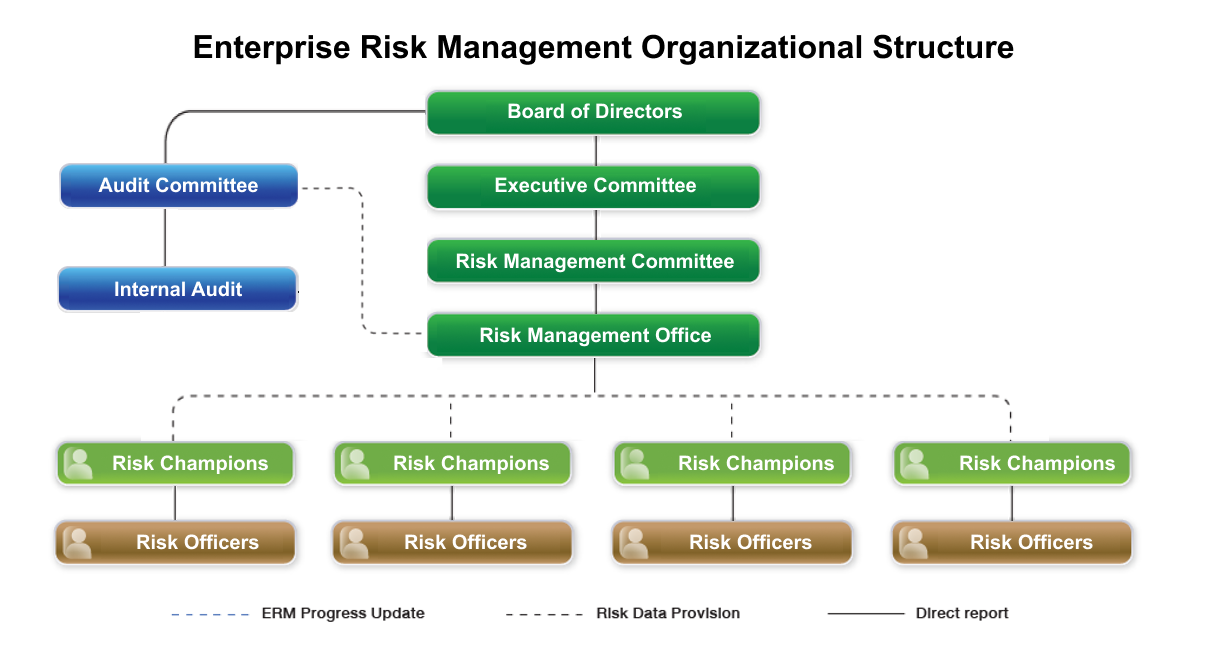
The RMC was first established under the oversight of the Board of Directors (the Board) and the Executive Committee (EC) to ensure that Group’s principal and substantial risks are identified and assessed, taking into account both internal and external disruptive factors. The RMC also promotes prudent risk management practices across the organization and encourages all relevant stakeholders to be well prepared for potential risk scenarios. In addition, the RMC reports quarterly to the Audit Committee (AC) on the progress of ERM workplan to ensure the effectiveness of the Group’s risk management framework.
Established by the RMC in 2015, the Risk Management Office (RMO) facilitates and exercises adequate oversight of the risk management practices employed by each of the respective business units. The RMO works proactively with the respective business units (BUs) leaders, Risk Champions, and Risk Officers to ensure the effective implementation of risk management processes and internal controls, including risk management training and communication across the Group. In 2025, RMC conducted a sharing session relating Human Rights Due Diligence to the Board and 5 sessions for employees, including Refinery in Malaysia, Asphalt business (Thailand), Marine business, Procurement, and Asphalt business (International subsidiaries).
Risk Monitoring
As part of the ERM practices, each risk is identified, updated and assessed in risk registers pertaining to each BU. Risk information includes objective, risk description, internal/ external context, risk category (according to COSO ERM classification; i.e., operational, strategic, reporting, and compliance), internal risk control measures (and their effectiveness), risk assessment (impact/likelihood), Key Risk Indicators (KRIs).
RMO asks each BU to provide key risks and KRI updates on a quarterly basis. Results are then analyzed and shared in the Quarterly Risk Report, which is submitted to the RMC members.
The RMC reports on the progress of top corporate risks in terms of risk level, Key Risk Indicators and mitigation plans to the EC and ultimately to the Board for acknowledgement/approval as the case may be.
The RMC also reports ERM workplan progress on a quarterly basis to ensure the Group’s risk management effectiveness to the AC.
Policy Document Link
https://www.tipcoasphalt.com/wp-content/uploads/2021/12/2023_EN_Annoucement-No.-7_2023-Enterprise-Risk-Management-Policy-signed.pdf
Page Number in Report
Page 1-2
Risk Factors — Overview
Risk Factors — Introduction
As an integral part of the Enterprise Risk Management (ERM) practices, the Risk Management Committee (RMC) collectively identifies a set of Top Corporate Risks by taking into account the six Corporate Strategic Goals (S6) that may impact the Group at the corporate level. These top corporate risks were initially identified in late 2017 and have since been reviewed and reassessed annually at the RMC meetings. Corresponding internal risk control measures have been carefully established and implemented as part of the risk mitigation process to enhance business resilience. The identified top corporate risks are subsequently presented to the Executive Committee and Board of Directors for acknowledgement and approval.
In 2025, top corporate risks were revised (in terms of risk level, key risk indicators and mitigation plans) and approved by the Board of Directors. In addition, RMO annually reviews the potential risk factors that may impact the Group to ensure the continued effectiveness of our dynamic risk management practices.
The RMC is also responsible for appointing Risk Champions (RCs) and Risk Officers (ROs) across the Group. Their roles include the identification, assessment, and management of risks within their respective business units (BUs) through the maintenance of the Risk Registers. Only high-level risks are reported on a quarterly basis through Quarterly Risk Report to members of RMC, with coordination and clarification provided by the RMO as needed.
The RMO conducts comprehensive risk reviews every two years to fully reflect potential risks arising from evolving business environments and changing market conditions. The first comprehensive risk reviews were conducted in 2020, followed by subsequent reviews in 2022 and 2024. The next round is scheduled for 2026.
Risks to the Company's Business Operations
Risk Register
| Risk Name | Risk Characteristics | Consequences | Management Measures | Related Risk Factors |
|---|---|---|---|---|
| Uncertainty associated with crude supply availability | Our asphalt cement (AC) production at our refinery requires specific types of crude with relatively high sulfur content which can only be procured from a select few crude sources. The Group relies on a small handful of sources for heavy crude oil supply, contributing to crude supply uncertainty. | This may result in low utilization rate of our refinery and sales volume for specific international markets. |
| 735 · Description: Reliance on large partners / distributors or few partners / distributors · Info category: STRATEGIC_RISK |
| Asphalt Cement (AC) Supply Risk | Asphalt Cement is the main raw material for the Group's production. | Shortage and fluctuations in Asphalt Cement supply and demand balances may result in production disruption. This, in turn, may lead to less total asphalt sales volume. |
| 740 · Description: Shortage or fluctuation in pricing of raw materials or productive resources · Info category: OPERATIONAL_RISK |
| Refinery Operating Risk | Environmental Risks Refinery operations involve the processing and storage of significant quantities of crude oil and hazardous materials, which poses inherent risks to the ecosystem. Accidental spills, leaks, or emissions can release various pollutants into the environment. In 2025, these risks are viewed through the lens of heightened environmental stewardship and the transition toward lower-carbon operations. Safety Risks Refinery operations involve the complex handling of flammable materials and toxic chemicals. As the facility has been in operation since 2008, a key focus for 2025 is the management of aging equipment and piping infrastructure to prevent mechanical breakdowns. These risks are further compounded by potential process control failures, human error, and hazards inherent in confined space operations. | Environmental Risks Failure to manage these operational risks may lead to environmental impacts for several aspects:
Safety Risks Failure to manage these operational risks may lead to severe safety incidents, including:
| Environmental Risks To mitigate these impacts, the refinery maintains a comprehensive environmental management framework. In 2025, we continue to prioritize the following measures:
Safety Risks The Company utilizes a proactive mitigation strategy combining stringent safety protocols, advanced monitoring, and comprehensive training. Specific measures to address asset integrity and aging equipment include:
| 749 · Description: Safety, occupational health, and working environment · Info category: OPERATIONAL_RISK · 751 · Description: Impact on the environment · Info category: OPERATIONAL_RISK |
| Risk related to Domestic Market | Asphalt demand remains closely linked to Thai government policies and annual budget allocations for infrastructure development projects. Therefore, asphalt demand is generally influenced by government stability as well as the 20-year National Economic and Social Development Plan. | In fiscal year 2025, government budget disbursement returned to a normal cycle following the delays experienced in the prior year. In addition, economic stimulus measures and accelerated infrastructure investment implemented during late Q3 through Q4 supported higher-than-normal asphalt demand. This may result in a shortage of asphalt deliveries for domestic customers. | To mitigate this risk, the Company enhances its market intelligence capabilities by monitoring and analyzing various market situations and developing appropriate response plans, while strengthening operational and commercial readiness to effectively respond to different scenarios. These include both recurring events and potential events that have not yet occurred but may arise in the future, thereby ensuring effective support for higher-than-normal sales volumes during peak demand periods. | 730 · Description: Government policy · Info category: STRATEGIC_RISK |
| Risk Related to International Business | Asphalt demand in Southeast Asia during 2025 remained broadly in line with 2024 levels, with no material growth observed. Demand was mainly driven by China and Vietnam, though overall consumption in these markets remained at the lower end of historical averages. In contrast, Indonesia experienced a significant slowdown, largely due to the suspension of new project(s) and decline of annual government infrastructure budgets. Meanwhile, asphalt demand in Oceania (Australia and New Zealand) remained stable throughout the year. Despite relatively steady asphalt in some markets, Asian asphalt prices particularly Korean-origin material declined sharply, reaching the lowest levels in the past five years during Q3–Q4 2025. This price weakness was driven by ample regional asphalt supply, softening high sulfur fuel oil (HSFO) values, and subdued regional demand. | The combination of weak asphalt demand and regional oversupply negatively impacted trading volumes and revenue performance in international markets. In addition, lower market prices, together with slower sales offtake, led to higher inventory holding costs, placing further pressure on margins. | To mitigate these risks, we are strengthening our market intelligence capabilities to closely monitor market dynamics and support more responsive asphalt supply planning as sales volumes gradually recover. In parallel, we focused primarily on floating pricing mechanisms to better align sales with prevailing market conditions, enhance pricing flexibility, and reduce exposure to market volatility. | 730 · Description: Government policy · Info category: STRATEGIC_RISK |
| Risk related to Marine Business | Environmental Risk The Marine Business operates under increasingly stringent environmental regulations issued by the International Maritime Organization (IMO) through the MARPOL Convention. These regulations aim to prevent pollution from operational and accidental sources and now place heightened emphasis on managing Greenhouse Gas (GHG), Sulfur Oxides (SOx), and Nitrogen Oxides (NOx) emissions. As global regulatory scrutiny intensifies—particularly regarding energy efficiency and the Carbon Intensity Indicator (CII), full compliance is essential to maintain operational continuity, competitiveness, and business sustainability. Safety-Related Risk Marine operations are governed by internationally recognized safety and security frameworks, including the ISM Code, ISPS Code, ISO standards, and OCIMF best practices. These standards form the foundation for our governance system, ensuring safe, reliable, and environmentally responsible operations across the fleet. | Environmental Risk Non-compliance with MARPOL and related IMO environmental regulations—especially those governing GHG, SOx, and NOx emissions—may lead to:
Increasingly stringent CII and energy-efficiency requirements may also affect fleet ratings and chartering opportunities. Safety-Related Risk Failure to comply with ISM, ISPS, ISO standards, or OCIMF best practices could result in:
| Environmental Risk We remain committed to safe, efficient, and environmentally responsible operations through:
These measures collectively improve environmental performance, reduce fuel consumption, lower emissions, and support sustainable cost control. Safety-Related Risk Crew Competency, Training & Welfare To reduce human-factor risks and strengthen operational reliability, the Marine Business has implemented:
Safety Culture & Leadership A strong safety culture is reinforced through the adoption of Shell’s Maritime Partners in Safety (PinS) program, which emphasizes leadership mindset, behavioral safety, human-factor awareness, and mental wellbeing as critical components of incident prevention and operational excellence. | 756 · Description: Change in laws and regulations · Info category: COMPLIANCE_RISK |
| Financial Risk | The Group’s business activities are exposed to various financial risks, including those related to credit, market, liquidity, foreign currency, and interest rates. The Group employs various financial instruments to manage identified financial risks but does not use them for trading or speculative purposes. The Group’s Finance Department operates as a service center, providing treasury advice, funding, and risk management assistance. It also liaises with financial institutions and manages financial risks related to the Group’s overall operations to ensure that Tipco Asphalt’s strategic objectives are met. The use of financial instruments is strictly controlled by policies approved by the Board of Directors. The policies provide specific instructions relating to financial risk management, which include credit, market, liquidity, foreign exchange, and interest rates risks as follows: Credit Risk The Group is exposed to the risk of financial loss arising from a counterparty’s failure to meet its contractual obligations, specifically when a customer fails to pay invoices on time. Market Risk The Group has identified market risk arising from fluctuations in oil product prices as material exposure. Volatility in crude and refined product prices—driven by supply-demand dynamics, geopolitical developments, and broader macroeconomic factors—may adversely affect inventory values and financial performance. Foreign Exchange Rate Risk The Group is exposed to risks arising from fluctuations in exchange rates from both operating transactions and long-term contractual commitment denominated in foreign currencies relative to each entity’s functional currency. Liquidity Risk Liquidity risk refers to the Group’s potential inability to meet its short-term financial obligations as they fall due. It could arise from mismatches between cash inflows and outflows, limited access to funding, or insufficient liquid assets. Interest Rate Risk Interest rate risk arises from adverse movements in market interest rates that affect funding costs and asset values. One dimension is the risk of rising borrowing costs of working capital. A separate dimension relates to fixed-rate positions that limit the Group’s flexibility to adjust to changing market conditions. | The risks may affect funding availability, cost management, and resource allocation, potentially influencing the Group’s ability to achieve its strategic objectives and maintain operational efficiency. Over time, such challenges could undermine the Group’s market competitiveness and long-term stability, while also posing potential obstacles to growth and sustainability. This underscores the importance of maintaining robust financial oversight and implementing adaptive risk management strategies to mitigate potential adverse effects as follows: Credit Risk High levels of expected credit losses, as a result of rising overdue receivables, lead to direct decreases in net profit and restrict cash flow for operations. Failure to properly manage credit risk may result in increased bad debt provisions, and eventual write-offs. Persistent non-payment weakens cash flow, strains working capital which may necessitate additional borrowings. Market Risk Market price declines directly reduce the margins on goods sold. When prices fall significantly, the market value of inventory may drop below its original cost, requiring an adjustment to Net Realizable Value (NRV). This adjustment results in an immediate non-cash charge to the income statement and negatively impacts overall earnings. Foreign Exchange Rate Risk Adverse currency movements can reduce margins, increase costs, and create unexpected and significant losses on transactions and long-term contracts. Liquidity Risk Under elevated liquidity risk, the Group may face delays in settling obligations, increase in financing costs, and heavier reliance on short-term borrowings. In more severe cases, it could disrupt operations or weaken stakeholder confidence. Interest Rate Risk Rising interest rates can increase the cost of borrowing, directly reducing the Group's profitability. In addition, once the Group enters into a long-term borrowing arrangement, it may have limited ability to renegotiate terms in a rising-rate environment, which could result in higher interest obligations than under floating-rate structures. | Credit Risk The Group’s credit policy is reviewed and updated on a regular basis to ensure alignment with evolving business conditions and risk management standards. As part of this policy, comprehensive credit assessments are conducted for all customers. Credit approval authority is delegated through the Credit Committee, which evaluates and authorizes credit sales based on continuously monitored customer-level credit risk profiles. Also, the Group works closely with its customers to tailor and meet its collection target and to solicit more collateral from customers than in preceding years. Market Risk The Group employs a range of strategies to enhance the market value of its sold products. The Group strategically allocates a significant portion of its asphalt volume to retail markets, where selling prices offer more favourable margins. Ongoing operational improvements are implemented to support more efficient production of high-grade asphalt. The Group also entered into derivative contracts to hedge against price fluctuations on its inventory, especially non-asphalt products. Foreign Currency Risk: The Group mitigates foreign exchange risk by identifying and utilizing natural hedges, aligning foreign currency inflows and outflows where possible to reduce net exposure. Significant remaining exposures are managed through the use of forward contracts to limit the impact of adverse currency movements. Liquidity Risk: The Group operates under unsecured short-term trade and working capital facility arrangements with reputable local and international banks that have a combined limit of over Baht 38 billion or USD 1.2 billion. This amount is more than enough to support higher financing requirements for feedstock purchases in times of elevated oil product prices. Interest rate Risk: The Group manages interest rate risk based on the duration of its borrowings. For short-term working capital facilities, it takes into consideration market conditions and interest rate trends when determining borrowing terms and does not use derivatives given the limited tenor of exposure. | 763 · Description: Default on payment or exchange of goods · Info category: FINANCIAL_RISK · 764 · Description: Fluctuation in exchange rates, interest rates, or the inflation rate · Info category: FINANCIAL_RISK · 1724 · Description: Liquidity risk · Info category: FINANCIAL_RISK · 767 · Other name: Product price volatility · Description: Other · Info category: FINANCIAL_RISK |
| Risk related to Information Technology and Cybersecurity | Information Security Risk The Group’s increasing reliance on technology to support and enhance its operations may result in greater exposure to risks such as cyberattacks, and data breaches. These risks arise from the growing complexity of digital systems, the interconnectivity of networks, and the sophistication of cyber threats. Additionally, the need to comply with data privacy laws and regulations further underscores the importance of effectively managing and mitigating these vulnerabilities to safeguard sensitive information and maintain operational integrity. Access Control Risk The Group is exposed to risks related to access control, particularly unauthorized access to critical systems and sensitive information. These risks arise from potential vulnerabilities in authentication, mismanagement of user permissions, or lapses in access protocols. Operations Security Risk The Group’s increasingly complex IT systems heighten the risk of operational failure. Disruptions in information processing facilities or failures in system integration may impact daily operations and overall business performance. | Information Security Risk The Group is exposed to the potential impact of information security risks, which may result in operational disruptions, financial impact, and reputational damage. Access Control Risk Unauthorized access to sensitive information may lead to data breaches, operational disruptions, and compromised system integrity. It could also expose the Group to reputational damage, legal and regulatory issues, and financial losses. Operations Security Risk The increasing complexity of the Groups IT systems may lead to operational disruptions, affecting the efficiency of daily operations. Potential failures in system integration or processing facilities could result in delays, loss of productivity, and impact on overall business performance. | Information Security Risk
Access Control Risk
Operations Security Risk
| 1720 · Description: System disruption risk · Info category: OPERATIONAL_RISK |
| ESG Risk | Environmental Risks Our environmental risks focus on business operations and transportation activities. Key risks identified were pollution, greenhouse gas emissions, climate crisis, wastewater management, and product spillage. Social Risks Social risks were identified in relation to inadequate safety measures and unsafe working conditions affecting health and safety of public road transportation and related employees. Human rights violations are another key social risk we prioritize. Examples of potential human rights violation risks identified include the fair treatment of employees and protection of the livelihood of local communities. Governance Risks Governance is one of our Sustainability Development foundations. RMO has identified some governance risks; for instance, corruption risk. | Environmental Risks Environmental risks, which are pollution, greenhouse gas emissions, climate crisis, wastewater management, and product spillage may have significant environmental, health-related, regulatory, and business impacts, as follows.
Social Risks The consequences of social risks arising from inadequate safety measures and unsafe working conditions may include transportation accidents, injuries, and fatalities affecting both the public and employees. Employees may face increased exposure to workplace hazards, insufficient safety procedures, and limited access to medical support. These issues could lead to legal liabilities, reputational damage, increased insurance premiums, operational disruptions, and reduced workforce productivity. Failure to effectively manage human rights risks may result in legal and regulatory penalties, financial losses, and reputational damage. Such violations could undermine employee trust and morale, lead to labor disputes, disrupt operations, and negatively impact relationships with local communities. In the long term, these issues may weaken stakeholder confidence, affect the Group’s social license to operate, and hinder sustainable business growth. Governance Risks Corruption risks may harm a business through legal penalties, reputation damage, and loss of trust from stakeholders while also affecting employee morale and creating a toxic work environment. Overall, corruption undermines long-term growth and sustainability. | Environmental Risks Several control points have been implemented to reduce the environmental impact of our business activities. These include
Social Risks Proactive policies and ethical practices help mitigate social risks as follows,
Governance Risks
| 1717 · Description: ESG risk · Info category: STRATEGIC_RISK |
Risks to Securities Holders' Investment
Risk Register
| Risk Name | Risk Characteristics | Consequences | Management Measures | Related Risk Factors |
|---|---|---|---|---|
| Risk related to the Company’s major shareholders holding more than 25% of the existing shares | The Company has two major shareholders, each holding more than 25% of the existing shares: Colas. S.A. and Tipco Foods & Supsakorn Family, which holds 31.09% and 29.96% of total paid-up capital, respectively, as of the end of 2025. | Such shareholders may veto any agenda item at the Annual General Meeting that requires affirmative votes of no less than three-quarters of the total votes of shareholders attending the meeting and entitled to vote. | Nevertheless, pursuant to the Company’s Articles of Association, resolutions in normal cases are passed by a majority vote of shareholders attending the meeting and entitled to vote. | 768 · Description: Return from investment of securities holder · Info category: HOLDER_RISK |